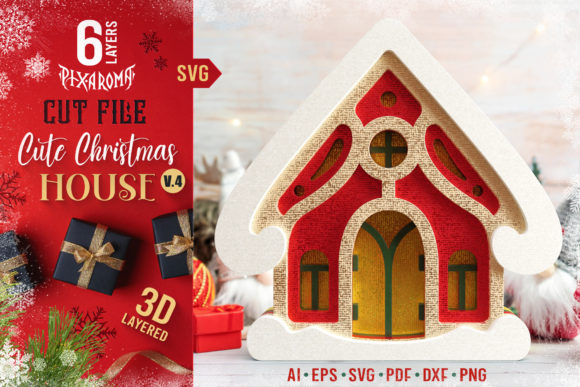
Cute Christmas House: An Embroidery Design Review
As a designer who spends more time behind an embroidery machine than at a computer screen, I approach every new digital asset with a healthy dose of skepticism. When I first opened the Cute Christmas House files, my immediate thought was not about how pretty it looked on a monitor, but how it would behave under the needle. The product is marketed as a 3D Layered Cut File V4, which immediately signals its origins in the paper crafting and vinyl world. However, for those of us in the textile space, this presents a unique opportunity and a specific set of challenges. Translating a layered cut file into a successful machine embroidery design requires understanding structure, stability, and visual hierarchy.
My first impression of Cute Christmas House was that it possesses a distinct, nostalgic charm. The geometry is clean, suggesting a stylized aesthetic rather than photorealism. This is excellent news for embroiderers because stylized shapes generally digitize better than complex illustrations. The "cute" factor here relies on proportion and balance rather than intricate detail, which means the design has strong potential for various holiday embroidery projects without becoming a muddy mess of thread. It feels like a design that belongs on a cozy, handmade product rather than mass-produced merchandise.
Real-World Application: The Holiday Tote Bag Test
To truly evaluate this asset, I mentally placed it in a real-life production scenario. Imagine preparing a batch of custom canvas tote bags for a local holiday market or an Etsy shop update. A tote bag is the perfect testing ground because the fabric is stable yet textured, and the end-use demands durability. For this project, Cute Christmas House would serve as the central focal point.
In this scenario, I would treat the original 3D SVG layers as a blueprint for an applique design. Instead of relying solely on heavy fill stitches to create the house shape, I would use the layered file to cut fabric pieces (using a laser cutter or vinyl cutter) and then secure them with embroidery. This hybrid approach reduces stitch count significantly while adding tactile depth that customers love. The visual personality of the house suggests it would pair beautifully with natural linen or cream canvas, using deep reds, forest greens, and metallic gold threads to create contrast. As an Etsy seller, listing a finished product featuring this design requires high-quality photography; the clean lines of the house make for excellent printable mockup material, allowing buyers to visualize the final tote bag design before purchasing.
Translating Cut Files to Stitch Logic
It is vital to remember that a cut file is not inherently an embroidery file. If you are a creative entrepreneur looking to use Cute Christmas House for commercial embroidery, you must verify if a pre-digitized version exists or if you will be digitizing it yourself based on the SVG template. Assuming you are creating or adapting the design, pay close attention to the translation of layers.
- Satin Stitch vs. Running Stitch: The outer edges of the house elements in a cut file are smooth vectors. In embroidery, these translate best to satin stitches or edge-run appliqué stitches. Avoid using simple running stitches for borders on items that will be washed frequently, as they can pull away from the fabric.
- Fill Stitch Density: If you choose to stitch out the entire house rather than using appliqué, monitor your stitch density. Layered designs often imply overlapping elements. In paper, this is fine; in embroidery, stacking dense fills creates bulletproof patches that can pucker the fabric or break needles.
- Detail Management: Windows, door knobs, and roof textures need to be simplified. What looks like a charming detail in a vector graphic can become indistinguishable thread clutter at 4x4 inches. Prioritize bold shapes over tiny accents.
Fabric Compatibility and Stabilizer Strategy
The success of Cute Christmas House depends heavily on where you place it. During my evaluation, I considered how this design interacts with different substrates common in small shop product lines.
For sweatshirt embroidery, the design’s blocky nature is forgiving on fleece fabrics. However, because sweatshirts have stretch and nap, you must use a cutaway stabilizer and potentially a water-soluble topping to prevent the stitches from sinking into the fabric pile. Conversely, if you are attempting baby embroidery on onesies or bibs, caution is required. The multiple layers implied by the "3D" description could result in a stiff, uncomfortable patch against sensitive skin. For baby items, I recommend reducing the design to a single-layer outline or light fill stitch version to maintain softness.
Textured fabrics like tea towels or burlap require careful planning. The crisp lines of Cute Christmas House might get lost in a coarse weave. In these cases, increasing the underlay stitches helps create a smooth foundation. Always test on scrap fabric first. A design that looks perfect on screen can distort wildly on unstable weaves if the proper stabilizer isn't used.
Commercial Viability and Product Value
For handmade shop owners and apparel decorators, time is money. Cute Christmas House offers good commercial viability because of its versatility. It scales well from a 2-inch pocket logo to a 6-inch pillow centerpiece. This scalability allows you to create cohesive collections across different products using the same design assets.
However, perceived value relies on execution. A poorly registered layered design looks amateurish. Ensure your hoop size is appropriate; cramming a large design into the maximum area of a small hoop leaves no room for error. Proper tension and hooping are non-negotiable. When selling personalized gift items, the cleanliness of the stitching builds customer trust. Buyers recognize quality. If the roof lines are straight and the colors align perfectly, the item justifies a higher price point. Furthermore, always confirm licensing. Just because you bought the 3D SVG does not automatically grant rights to sell digitized embroidery versions or mass-produced goods. Check the specific terms for commercial embroidery usage to protect your business.
Designer Notes for Best Results
Before loading Cute Christmas House into your machine for a client order or shop stock, run through this practical checklist:
- Contrast Check: Test thread colors against both light and dark backgrounds. A white house on cream fabric needs a darker outline to define the shape.
- Mockup Validation: Create black and white mockups to see if the design holds up without color reliance. If it reads clearly in grayscale, the structure is sound.
- Wash Testing: If making kitchen towels or custom apparel, wash and dry a sample. Layered designs can sometimes separate at the seams after laundering if not secured properly.
- File Verification: Confirm the specific file format compatibility with your machine brand. Do not assume universal compatibility.
- Scale Appropriateness: Resize carefully. Drastically enlarging a cut-file-based design can expose gaps between elements, while shrinking it can cause thread breaks.
Cute Christmas House is a delightful asset with strong potential for the holiday season. Its strength lies in its adaptability from digital craft to textile art. By respecting the differences between cutting and stitching, and by applying professional stabilization and digitizing standards, you can transform this charming graphic into a profitable, high-quality finished product that brings genuine joy to your customers.